

Making Space in Our Minds for Thinking in Larger Groups: A Reflection on Foulkes Lecture, May 9 – 10, 2025
On Friday, I was inspired by Teresa von Sommaruga’s lecture titled The Architecture of the Larger Group: Politics, Community, and Culture. Beyond being a comprehensive overview of the history of larger groups—focusing on Patrick de Mare’s legacy, group analytics, and conductors—it struck me as a deeply personal story. Teresa shared her experience as part of Patrick de Mare’s group from the beginning, gradually shaping her own way of leading and conducting. I could sense her intimate relationship with her mentor and the group, which felt like a second family—or even a safe space where she felt accepted and free to find her own voice, to learn and grow, and to create similar spaces for others.
Her sense of freedom was palpable, especially in the response speech following her lecture, delivered by Anando. His remarks were refreshing — inclusive and inviting, encouraging open discussion rather than simply showcasing his knowledge or offering a fixed point of view. I appreciated his seeming unpreparedness; he stayed grounded with us, without reacting defensively, just being present. This allowed us, and him, to remain curious, open, or even tired — a vulnerability that fostered genuine connection.
The way Teresa and Anando opened Friday’s Foulkes lecture created a portal to a very engaging Study Day on Saturday. The day began with an interesting interplay within a small circle group, followed by a reflective group circle involving others. Ultimately, the entire group (including those on Zoom) engaged in a larger conversation. I participated in an in-person group that was part of this hybrid setting.
During the first reflective group circle — centred around concentric circles with only eight participants — I faced difficulties seeing and hearing everyone clearly. To help manage this, I started drawing, as I often do in group settings lately (see Drawing 1). This technique allowed me to create extra mental space, follow the conversation more freely, and connect a series of images: George Orwell’s Animal Farm, a clown from It, “shit hitting the fan,” a pile of feces, peanuts, ivy, digital networks, interconnected neural pathways, sensory and emotional flows, a balloon, a rat, dark hidden places, and small holes or gaps in our minds.
Afterward, in a reflective group, I shared some associations from my drawings, describing the images from my mind. One participant remarked that he never thinks in this way, and that he tries to share in the group only what he perceives as ‘smart thoughts”. Later, he mentioned how difficult it is to make space for everyone in the room — both in person and on Zoom. I reflected on my drawings, which could serve to create that mental space. They operate in the pre-verbal, unconscious realm — allowing me to follow the group process differently, as a work in progress. It’s like a slowly evolving matrix, pieces gradually coming together — or not — and making room for new thoughts and associations to emerge from our social and unconscious minds.
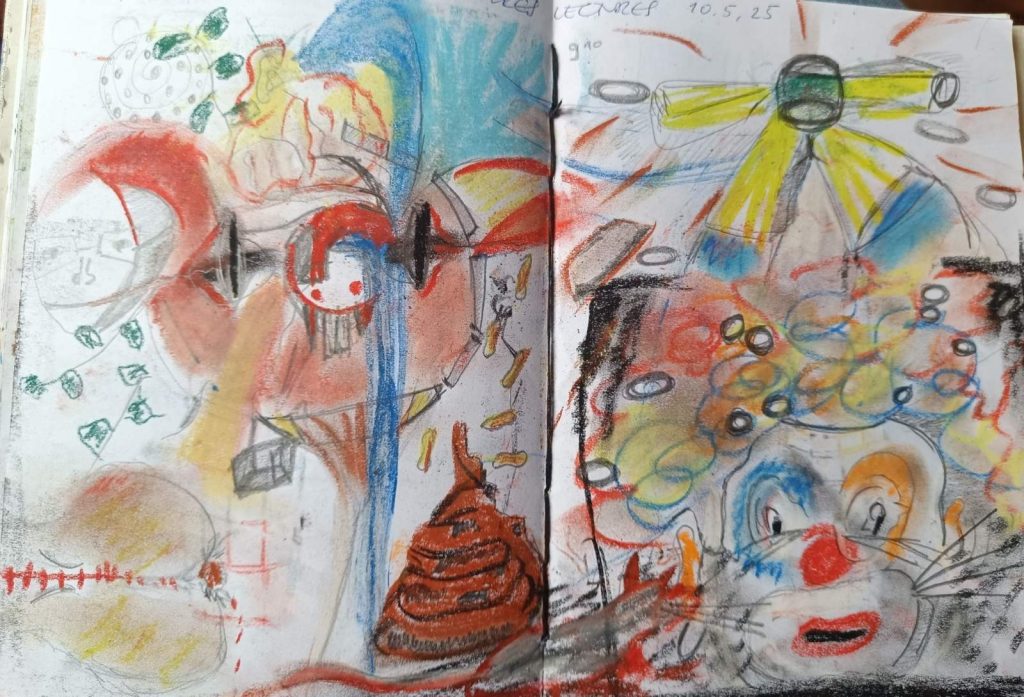
Drawing 1
In the next reflective group, I draw another drawing (drawing 2), where I was thinking of my experience from the bus on the way to the Study Day. We had a conversation on private gardens that are only for the special visitors with the key, and we joked that if somebody entered the gardens climbing the fence, would be hanged. I felt like the group would like to hang someone or more of them. And I had an association of garden of Eden and Adam and Eve and then there were boxes, perhaps the people on zoom, the cemetery, again a balloon, a trunk of a tree with big holes in them to hide or they can be a portal.
When I shared my story from the private gardens and about hanging somebody it was talked about that perhaps somebody would like to hang Teresa. It was talked about her lecture and that it was only one of the ways (perhaps not appropriate way?) of conducting larger groups. In the whole group conversation, a lot of tension started to build up, of things not being said, and conflicts not being resolved, not talking of the important topics, an elephant being in the room.
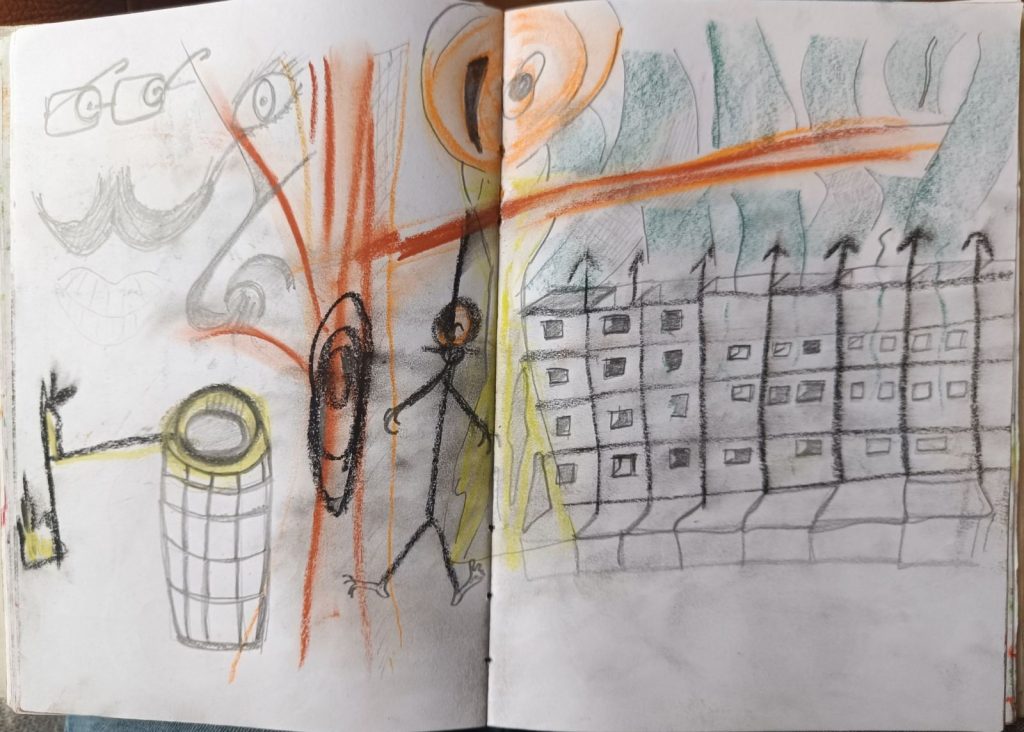
Drawing 2
In the first large group, a story was shared about a conflict between two participants, a younger female participant and a senior male participant. The entire group was deeply immersed in this intimate story, which seemed larger than them.
I drew a picture of two men who looked kind, opening doors and windows for being wrong and imperfect, being human. There was a split between them and a picture of empty chairs and knitted floors with squares, a small boat on a river of blood, a knife stabbed in the back, a woman with long hair and a wound or a portal in her back, and a big hand with broad fingers (drawing 3).
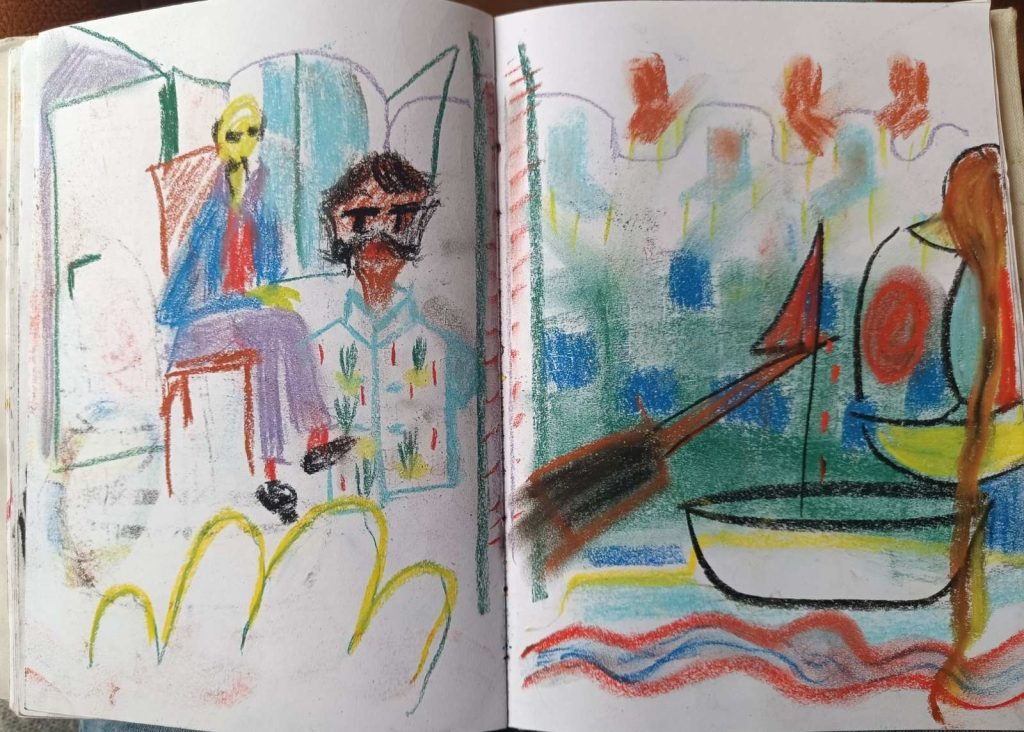
Drawing 3
In the next large group, I draw a donkey that looked in the mirror and saw a heart and a tear or a rain drop. On the other side of the picture there were very colourful drums that associated me on a tribal dance of mockery and charade, and a Pinocchio with a long nose when he tells a lie (drawing 4). The group felt surreal, a bit psychotic, like there was a real threat somewhere but nobody did not really want to acknowledge it or name it. Towards the end a woman from a chair in the third row, screamed and waved with her hands, almost standing up a bit, being very angry at one of a senior man. Like wanting to scream, the Cesar is naked.
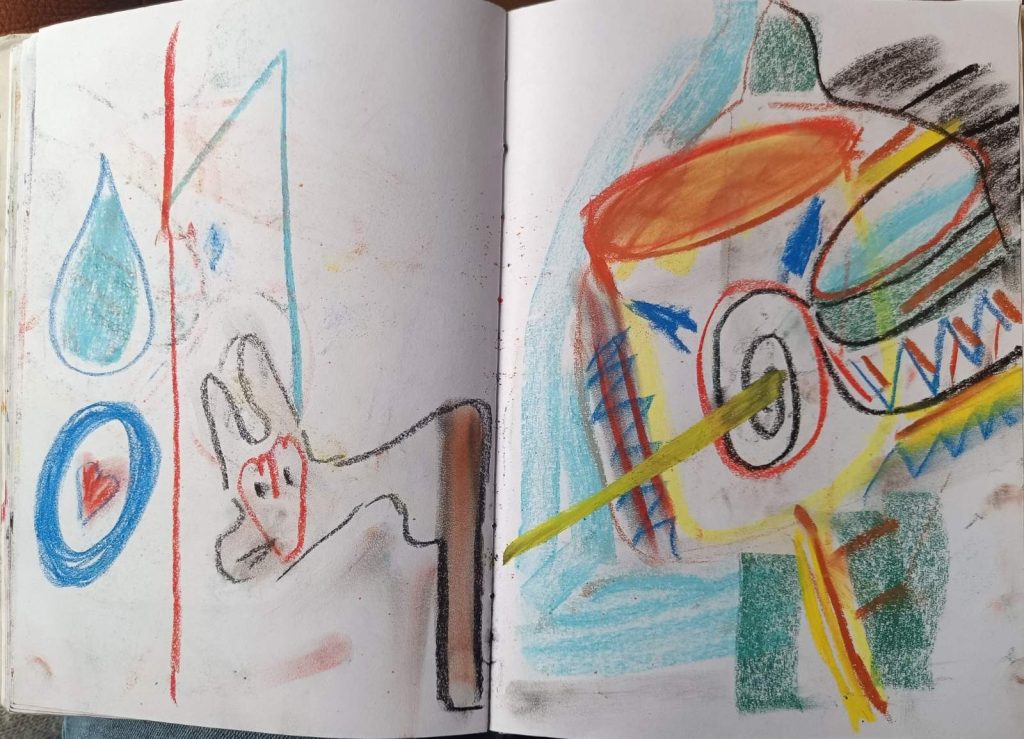
Drawing 4
The last large group continued with the conflict being located more and more between senior men, fighting like roosters, like they did not want to be forgotten when they die. The theme of disappearing woman opened, and it seemed like there are no important women in the society, dead or alive. Like the women don’t mind if they are being remembered or forgotten. It was questioned a bit this male female polarisation with changing gender roles in the present times.
I draw a picture (drawing 5) of a man in a brown tuxedo, without a face or perhaps with a white face, with blue curled wig and a red flag where the nose should be and red scissors or knives where the hands should be. It associated me on a children book Der Struwwelpeter (‘Shock-Headed Peter’) where each of a cautionary tale has a clear moral lesson that demonstrates the disastrous consequences of misbehavior in an exaggerated way. And on the opposite side there was a creature half lion half monkey, with a halo effect of a sun god. It reminded me of the movie Mune: the guardian of the moon, especially of the character Sohone, who was a guardian of the sun.
On the last drawing (drawing 6) there was a carcass being buried, with open rib cage and guts, with tentacles on the face. On the other side there was a ring, a vulva-like symbol that could also resemble a central place in Mordor where Gollum wanted to steal his Precious (ring) from Frodo the hobbit. Reflecting on the group with the associations from the drawing I am thinking that we tried to bury the strong senior men in the group that behaved like gods or guardians of the “proper” large analytic groups or better “we” saw them as such. I am bewildered about the last drawing though and thinking about what the next generation will look like and how it will fight for the precious future.
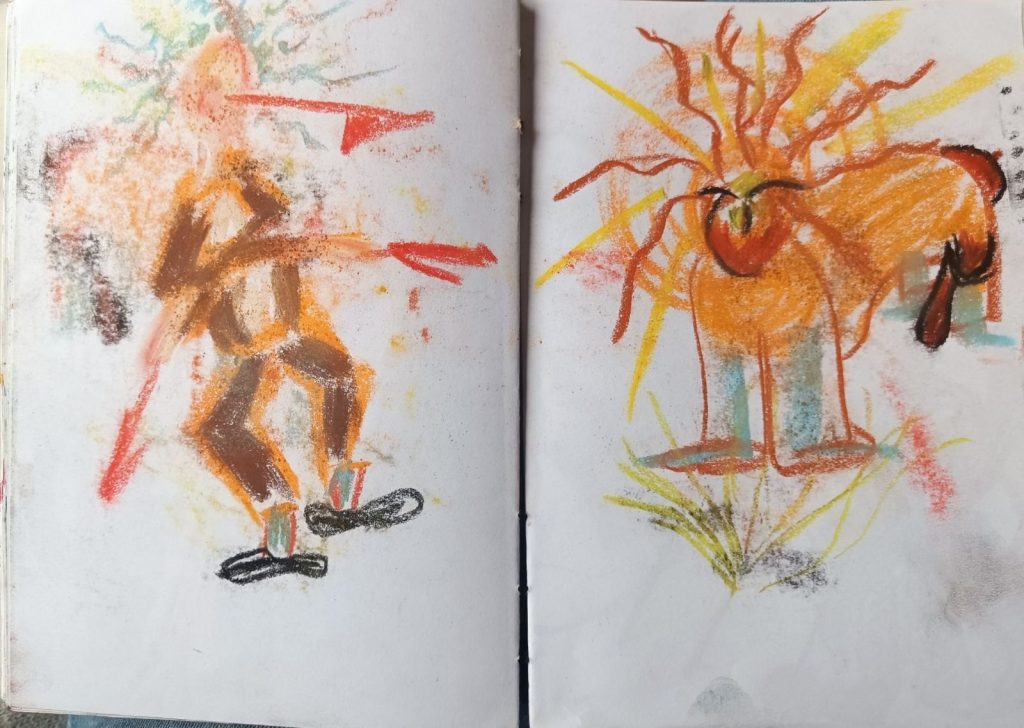
Drawing 5
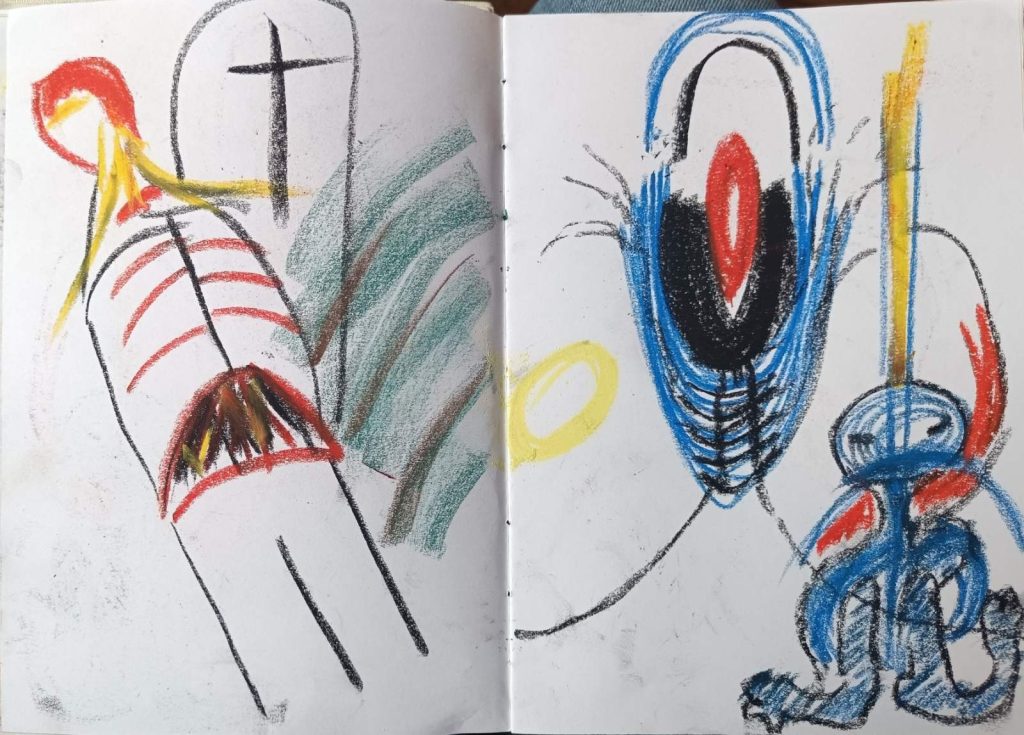
Drawing 6