

Imbalance in the Maelstrom: Some Reflections on the 2025 Summer School
The title of this year’s summer school, “Holding the Centre in the Maelstrom,” held at Roffey Park in West Sussex, was wisely chosen—precisely because the centre of a maelstrom is a dangerous place, with life-threatening sharp cliffs waiting at the bottom. For more than two years now, it has almost felt as if GASi, as an institution, has symbolically found itself in a situation comparable to a force of nature.
The short story “A Descent into the Maelström” by Edgar Allan Poe is a frightening and, at the same time, beautiful literary work of art. It also reflects the tragic and turbulent biography of the American author—an occasion to reflect more closely on the turbulent biography of GASi itself. From a literary perspective, important themes in the story include rationality versus madness, and external threats (forces of nature) versus internal threats (psychological abysses). The maelstrom—a symbol of chaos, death, and the unknown (the unconscious)—also represents the power of insight, because it is at the centre of chaos that the narrator finds clarity about his existence.
While “A Descent into the Maelström” celebrates the triumph of reason, many other Poe stories delve into the exploration of the human mind as a source of horror.
This provided an interesting starting point for a group-analytical summer school, where the future generation of group analysts meets the older generation to exchange ideas. I do not know how many participants read the short story before or during their stay in Sussex, but I listened to it as an audiobook before arriving and was very moved. The audio version is impressively accompanied by a jazz quintet—the tone makes the music, even in group analysis.
The short story and the fascinating image of the roaring sea accompanied me throughout my stay at Roffey Park—fascinating, attractive, and dangerous at the same time.
And yet, the maelstrom did not run quite smoothly. It was noticeable that there was no local British organising committee and that the organisers of the 2024 summer school in Turin did not make an appearance. There was discontent that Erica Burman, who was invited from outside—which I personally found insensitive, as she takes a very polarising position in the current conflict within GASi (see Group Analysis 58(2), 2025)—apparently received a fee for her contribution. Other speakers traditionally do not.
This was irritating not only from a financial point of view, but also in terms of content, as the large group leaders mentioned above have also clearly positioned themselves on one pole of the political spectrum of internal debate over the last two and a half years. Even a force of nature such as a maelstrom may, perhaps, become somewhat unbalanced in this context. The hope for tolerance of ambiguity in the eye of the storm or vortex remains slim.
The very beautiful conference picture painted by Aisling Fegan could also be seen as polarised waters rather than a circling ellipse with a centre point—but I will leave that up to each viewer to decide for themselves. I myself unintentionally created my own maelstrom in Aisling’s creative workshop. In retrospect, however, the work seems a little too optimistic and harmonious to me. Perhaps this is influenced by a childhood love: a friend who used to serve as a sailor on research ships off the Norwegian coast and now steers ocean liners through the shallows of the English Channel as a captain.
But let us return to the maelstrom. It worked continuously for five days, sometimes gently and bubbling, sometimes roaring and dangerous. It is surprising that there were no Norwegians present—as far as I know—who might have contributed something to the matrix of the Norwegian maelstrom. The young Israeli colleagues, who were still numerous last year, were also missing. This may well have something to do with the political struggles in Gaza since 7 October 2023.
I gained the impression that some Jewish participants from other countries were, at times, held responsible for the actions of the State of Israel—not as aggressively as at some public demonstrations in certain countries, but still quite clearly. This became particularly apparent in a scene in the large group led by Dick Blackwell and Marci Lopez, which I found highly symbolic. Throughout the summer school, there were repeated vocal and emotionally charged statements naming and evaluating events in the Gaza Strip. Arguments and political positions were exchanged among participants. At the height of one such debate, a senior member said to another, “I never thought we weren’t in the same boat.”
In addition to the polarisation and division that we have experienced more intensely in GASi for almost three years, I thought of the maelstrom and the core message of Poe’s short story. The brother of the main protagonist clings desperately to his fishing boat—with the best catch of their lives on board—as it is pulled into the depths of the maelstrom. Out of fear or horror, he cannot let go to take the daring leap onto a barrel that promises rescue. Only the narrator dares to take the risk of saving himself from the deadly vortex in an unconventional way.
Unconventional thinking and hard work were probably what was needed here. A cool breeze of de- idealisation swept through the sun-drenched room in Sussex.
An AI description states: *“West Sussex is a place that will delight history buffs, nature lovers, and coastal fans alike”—*perfect for a summer school. Nevertheless, a certain oppressive atmosphere hung over the event, which may have had many reasons—perhaps including the lingering presence of Poe’s work itself.
I recall these events with a sense of sadness: the splitting and mirroring of global political struggles among a circle of esteemed colleagues whose profession is, in fact, to view conflicts constructively and to endure difficult contradictions together—for as long as necessary. I wish us all the strength to do so as we look ahead to Athens 2026.
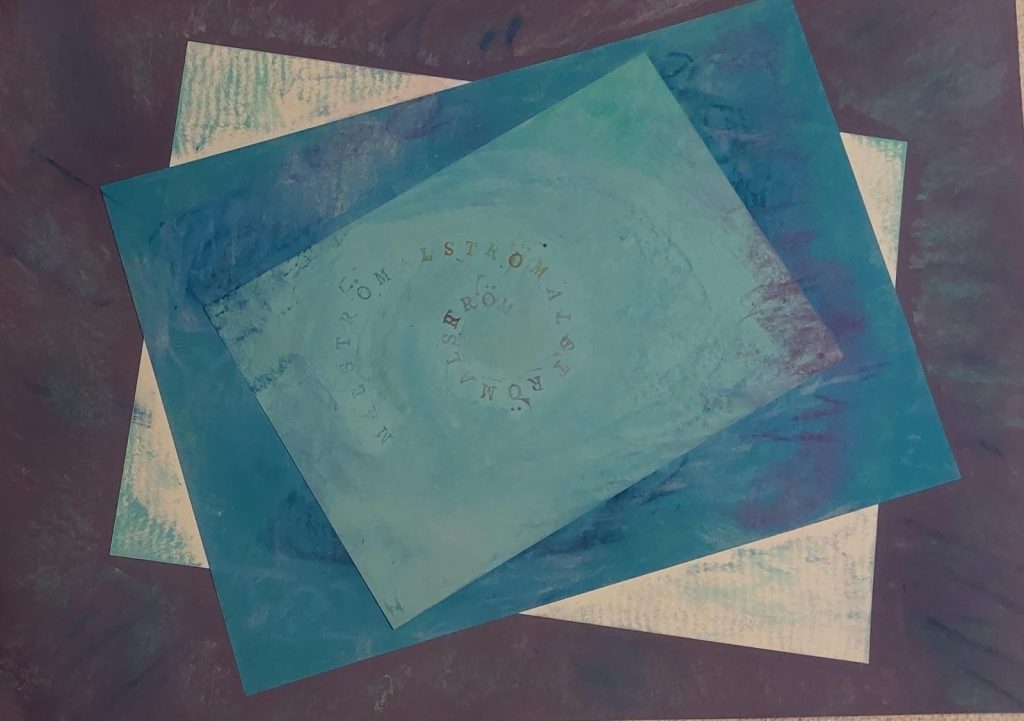
The following images were created during workshops conducted by Aisling Fegan, an artist, art psychotherapist and GASi member, over the course of the Summer School: